Talent Visas Compared: Singapore, Hong Kong, the United Kingdom and Switzerland
Singapore, Hong Kong and the United Kingdom have dedicated routes for top talent: without a job offer or with a clear salary threshold, a decision in around four weeks, family included. Switzerland has only the general quota procedure.
Current Checked on 08.11.2026 First published on 8 November 2026; figures and sources reflect the state at publication. Change log (1)
Singapore (ONE Pass), Hong Kong (Top Talent Pass Scheme) and the United Kingdom (Global Talent) have created dedicated admission routes for top talent. What they have in common: clear criteria instead of a case-by-case labour market test, a decision within around four to eight weeks, and family included. Switzerland has no such route; researchers and founders from third countries go through the same quota procedure as all qualified workers. The point here is a narrow, fast route for a few thousand people a year, not more general immigration.
Methodology
We compare criteria, processing times, family reunification and case numbers, in each case from the information published by the competent authorities: Ministry of Manpower (Singapore), Immigration Department and Labour and Welfare Bureau (Hong Kong), Home Office (United Kingdom), State Secretariat for Migration and Federal Council (Switzerland). The case numbers are not directly comparable: the Swiss quotas apply to all qualified workers from third countries, not only to top talent; for Hong Kong only cumulative figures are available. Two values are therefore marked as estimates.
Criteria and family
- Singapore, ONE Pass (since 2023): fixed monthly salary of at least 30,000 Singapore dollars with an established company, or outstanding achievements in research, science, culture or sport. Valid for up to 5 years; changing jobs, working for several employers or running one's own company without a new application. Spouses can work with a Letter of Consent.
- Hong Kong, Top Talent Pass (since end of 2022): annual income of at least HK$2.5 million or a degree from a university on the official list of top universities (with or without work experience). No job offer required. Stay of 24 to 36 months, extension only with employment or one's own company. Spouses are allowed to work.
- United Kingdom, Global Talent (since 2020): endorsement by a specialist body in research, culture or digital technology, or a recognised prize. No job offer required. Up to 5 years per grant, settlement possible after 3 or 5 years; partners and children can accompany.
- Switzerland, admission from third countries: application by the employer, proof of priority for domestic workers, local and industry-standard pay and working conditions, qualification as a manager, specialist or qualified worker (Art. 20–23 AIG [Foreign Nationals and Integration Act]). For 2025 and 2026, 8,500 quota permits apply in each year (4,500 B, 4,000 L). Family reunification for B permit holders is subject to conditions (Art. 44 AIG).
Processing time
Official guideline processing times for talent visas in weeks
Data ↗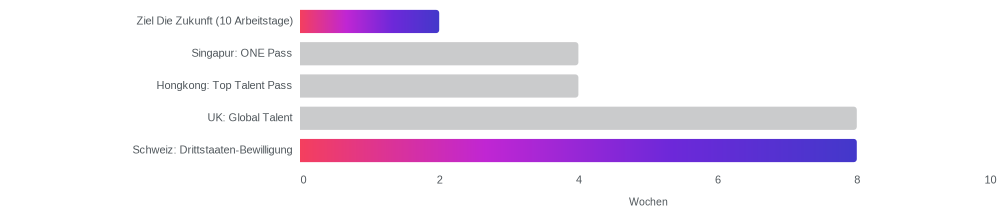
Case numbers
Permits per year for talent programmes and Swiss third-country quotas
Data ↗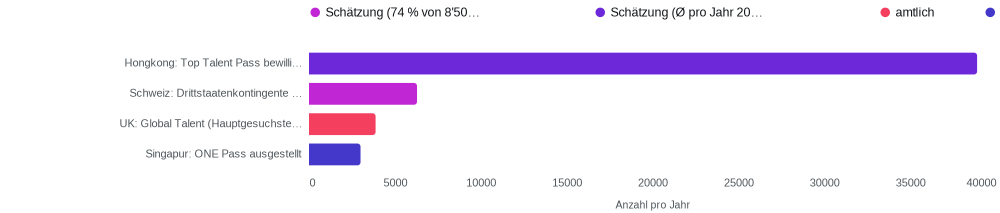
United Kingdom: stable demand, few refusals
UK Global Talent: visas granted to main applicants and dependants, 2019 to 2025
Data ↗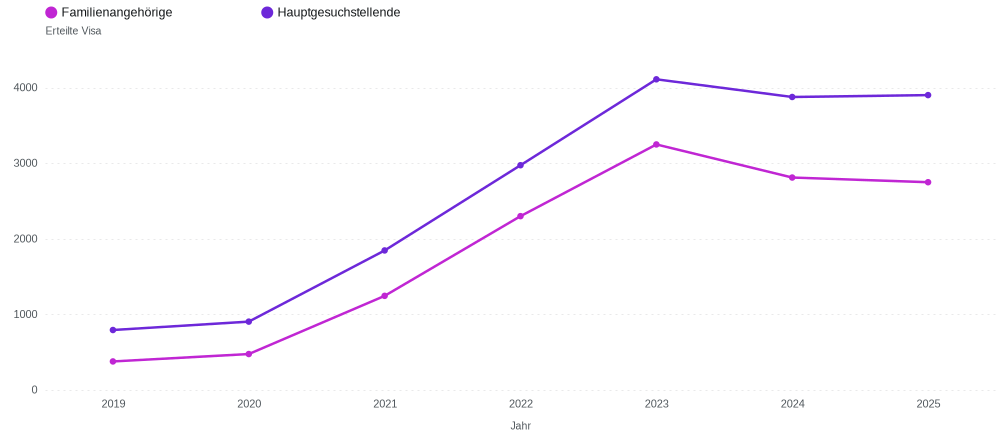
What this means for policy
- A dedicated talent visa outside the quotas: narrow, verifiable criteria (salary threshold or endorsement by the ETH Domain, universities, SNSF, Innosuisse), a decision within ten working days, family included: Talent, Integration & Rule of Law.
- Start small and measurable: an order of magnitude like the United Kingdom or Singapore (a few thousand per year), not like Hong Kong; an annual report on permits granted, retention and company formations.
- Measure retention, not volume: the Hong Kong example shows that extension rates are more meaningful than application numbers.
Sources
- Ministry of Manpower Singapore: ONE Pass, Eligibility, Key facts, Apply for a pass. https://www.mom.gov.sg/passes-and-permits/overseas-networks-expertise-pass
- Ministry of Manpower: Written answer to PQ on statistics on issuance of ONE Pass, 4 February 2025. https://www.mom.gov.sg/newsroom/parliament-questions-and-replies/2025/0204-written-answer-to-pq-on-statistics-on-issuance-and-management-of-one-pass
- Ministry of Manpower: Written answer to PQ on effectiveness of ONE Pass, 5 August 2026. https://www.mom.gov.sg/newsroom/parliament-questions-and-replies/2026/0805-written-answer-to-pq-on-effectiveness-of-overseas-networks
- Immigration Department Hong Kong: Top Talent Pass Scheme. https://www.immd.gov.hk/eng/services/visas/TTPS.html
- Labour and Welfare Bureau: Talent attraction, paper for the LegCo Panel on Manpower, 23 February 2026. https://www.legco.gov.hk/yr2026/english/panels/mp/papers/mp20260223cb1-165-5-e.pdf
- GOV.UK: Global Talent visa. https://www.gov.uk/global-talent and https://www.gov.uk/global-talent-researcher-academic
- Home Office: Immigration system statistics, Entry clearance visa outcomes (Vis_D02), year ending June 2026. https://www.gov.uk/government/statistical-data-sets/immigration-system-statistics-data-tables
- Federal Council: Bundesrat legt unveränderte Drittstaatenkontingente für 2026 fest [Federal Council sets unchanged third-country quotas for 2026], 19 November 2025. https://www.admin.ch/de/newnsb/7HwBjdg5HpBA
- SEM: FAQ Arbeit, Dauer des Bewilligungsverfahrens [FAQ on work: duration of the permit procedure]. https://www.sem.admin.ch/sem/de/home/themen/arbeit/faq.0010.html
- Bundesgesetz über die Ausländerinnen und Ausländer und über die Integration (AIG) [Federal Act on Foreign Nationals and Integration], SR 142.20. https://www.fedlex.admin.ch/eli/cc/2007/758/de
Data & code
- Data (CSV)
- Chart data (JSON) · talent_bearbeitungszeit
- Chart data (JSON) · talent_erteilungen
- Chart data (JSON) · talent_uk_verlauf
- Code & notebook on GitHub
Change log
- First publication.
Cite as: Die Zukunft, Zukunftslabor (2026): «Talent Visas Compared: Singapore, Hong Kong, the United Kingdom and Switzerland». https://die-zukunft.ch/en/zukunftslabor/notizen/talentvisa-im-vergleich/ · CC BY 4.0