Talent & Migration: Are Qualifications Being Used — or Left Unused?
36% of third-country nationals work below their level of qualification. This is not an integration failure — it is a loss of value added.
Partly outdated Checked on 08.11.2026 Population and migration data up to 2024 checked; the overqualification values by sector and the loss estimate are based on assumptions and have not been updated with current SLFS data. Change log (1)
In 2024 Switzerland recorded net migration of +82,792 people. Yet many qualifications remain unused: 36% of third-country nationals work below their level (vs. 13% of Swiss nationals). According to our own rough estimate, this means around CHF 3.6 billion in forgone wages per year.
Methodology
Population data: FSO Population and Households Statistics (2010–2024). Migration data: FSO migration statistics (1991–2024). Overqualification: FSO Structural Survey / SLFS (self-assessment + formal qualification), supplemented by the OECD Indicators of Talent Attractiveness 2023.
The loss estimate is our own rough estimate: around 200,000 overqualified immigrant workers × an assumed wage gap of around CHF 18,000 per year ≈ CHF 3.6 billion. Both values are assumptions, not published statistics; the figure indicates an order of magnitude.
Foreign population by permit type
Foreign population by permit type over time
Data ↗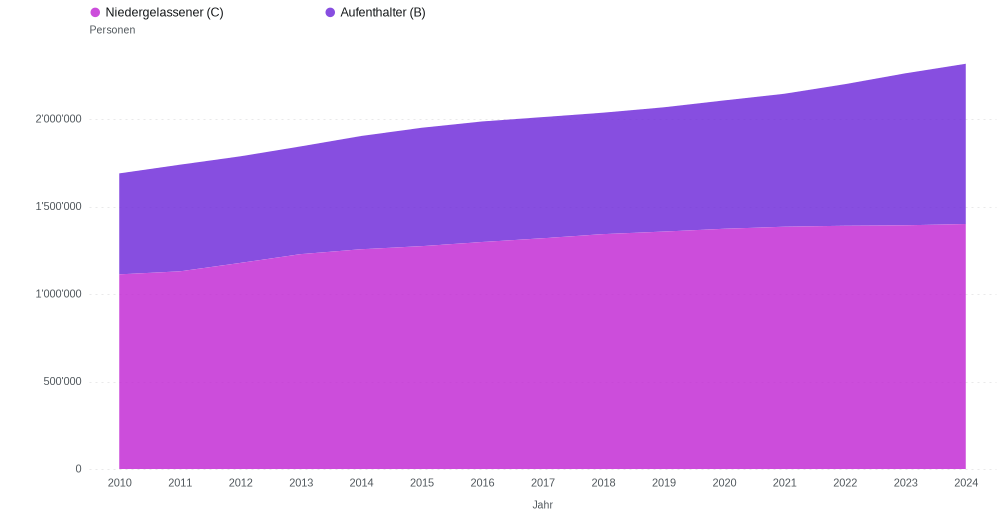
Net migration by origin
Net migration by region of origin
Data ↗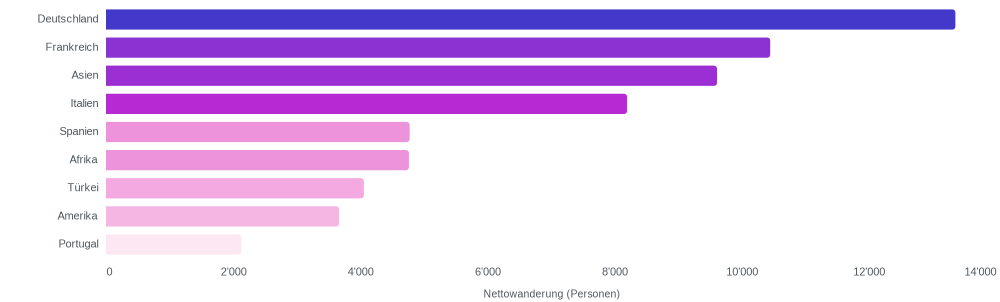
Overqualification rate by origin group
Overqualification rate by origin group
Data ↗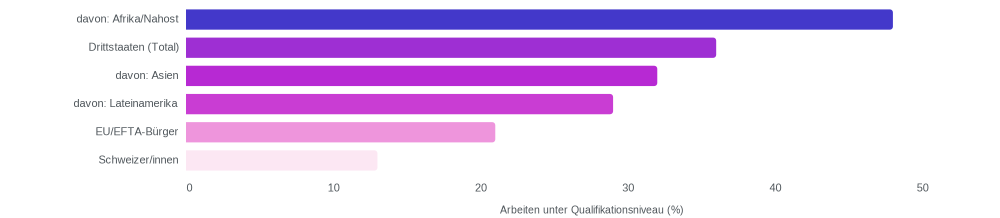
Sectors with a high share of overqualification
Industries with the highest share of overqualified employees
Data ↗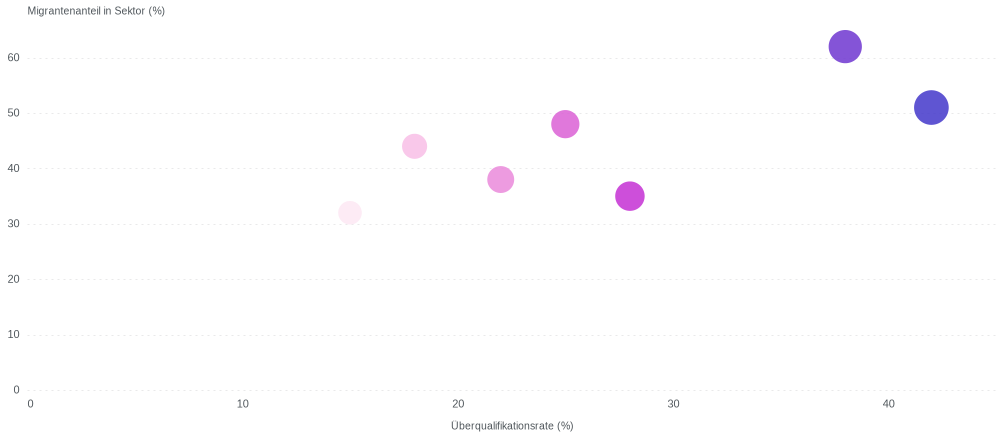
Limitations
- Overqualification is based on self-assessment and formal recognition of diplomas
- Not all foreign diplomas are automatically equivalent (language barriers, protected professions)
- The estimate of economic loss is our own rough estimate with assumed values (number of people affected; the wage gap varies widely by sector)
- SLFS data are sample data with confidence intervals
Data sources
- FSO: Population and Households Statistics (STATPOP)
- FSO: migration statistics (international migration)
- FSO: Structural Survey — employment by qualification and nationality
- OECD: Indicators of Talent Attractiveness 2023
Data & code
- Chart data (JSON) · migration_herkunft_trend
- Chart data (JSON) · migration_nettowanderung
- Chart data (JSON) · migration_ueberqualifikation
- Chart data (JSON) · migration_ueberqualifikation_sektoren
- Code & notebook on GitHub
Change log
- Statements on the foreign population aligned with the data, the judgemental wording "wasted" replaced with "unused" and the CHF 3.6 billion loss estimate labelled as our own rough estimate with its method.
Cite as: Die Zukunft, Zukunftslabor (2026): «Talent & Migration: Are Qualifications Being Used — or Left Unused?». https://die-zukunft.ch/en/zukunftslabor/notizen/talent-ueberqualifikation/ · CC BY 4.0