Compute and Electricity: What Ten Times More Public AI Capacity Would Require
In 2024 data centres used around 2.1 TWh, or 3.6% of Swiss electricity. By our estimate, a tenfold increase in public compute based on Alps would require 0.6 to 0.8 TWh per year: manageable with planning, but not as an afterthought.
Current Checked on 08.11.2026 First published on 8 November 2026; figures and sources reflect the state at publication. Change log (1)
Switzerland's data centres consumed around 2.1 terawatt hours of electricity in 2024, 3.6% of national consumption. By 2030 the Swiss Federal Office of Energy (SFOE) expects 2.5 to 3.2 TWh, and 3.5 TWh in its maximum scenario. The country's largest public AI computer, Alps at CSCS in Lugano, drew around 7.1 megawatts during its official performance measurement. By our estimate, ten times as much public compute with today's technology would require 0.6 to 0.8 TWh per year, i.e. just over 1% of today's final consumption.
Methodology
We combine three official or primary sources: the SwissEnergy/SFOE study on the electricity consumption of data centres (May 2026), the SFOE's 2025 electricity balance and the measured power draw of Alps in the TOP500 list (7,124 kW, Level 3 measurement). Alps comprises 10,752 NVIDIA GH200 superchips in 2,688 nodes (CSCS).
The projection for a tenfold increase is our own estimate with deliberately simple assumptions: continuous operation for 8,760 hours per year at the measured Linpack power, scaled linearly. For cooling and building services we assume a 30% surcharge (PUE 1.3); this is an assumption, not a measured value for Alps. Newer chips deliver more computing power per watt, so the estimate is more of an upper bound for "ten times Alps".
Data centres are growing, but predictably
Electricity consumption of Swiss data centres in 2019 and 2024 and SFOE scenarios for 2030
Data ↗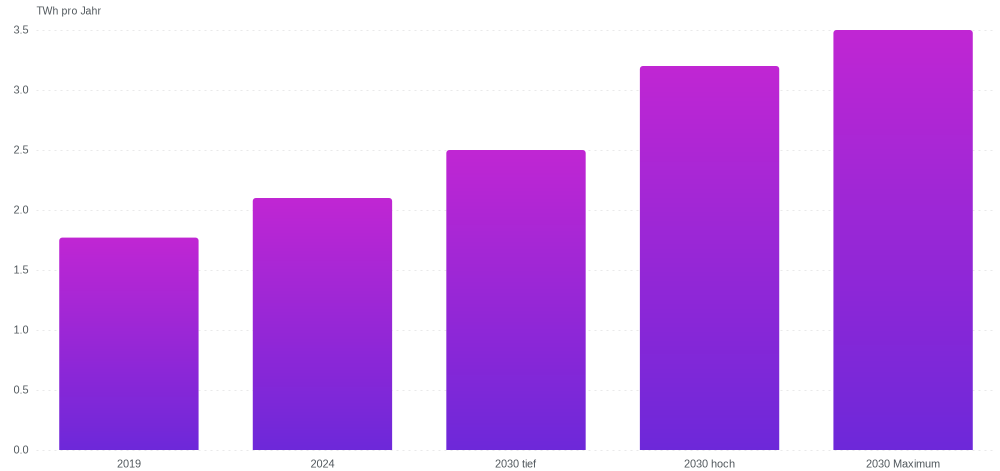
The starting point on the grid
Swiss electricity production in 2025 by source in terawatt hours
Data ↗
What a tenfold increase would cost, in electricity
Estimated annual electricity demand of ten times Alps compared with the consumption of all data centres
Data ↗
What this means for policy
- Plan energy and compute together. A public AI programme of the order of 70 to 90 MW is feasible for the Swiss grid, but it needs fixed sites with grid connection, cooling and waste-heat recovery. This belongs in the same planning as the expansion of winter production: Energy & Infrastructure Resilience.
- Realise efficiency first. The identified efficiency potential of around 0.8 TWh in existing data centres corresponds roughly to the estimated demand of a tenfold increase in public compute. Binding efficiency metrics for large data centres free up room on the grid.
- Expand public compute measurably. Report targets and progress in megawatts and computing power, with open access for universities, SMEs and the administration: Sovereign AI & Compute.
Sources
- Swiss Federal Office of Energy / SwissEnergy: Stromverbrauch der Rechenzentren in der Schweiz [electricity consumption of data centres in Switzerland], press release of 7 May 2026. https://www.admin.ch/de/newnsb/GV-_d7OgIlqjfQDGZqbkN
- Swiss Federal Office of Energy: Elektrizitätsbilanz 2025 [electricity balance 2025], press release of 18 June 2026. https://www.admin.ch/de/newnsb/YQtEZcK-D9fQ
- TOP500: Alps, HPE Cray EX254n, CSCS (power draw 7,124 kW, lists November 2024 to June 2026). https://www.top500.org/system/180259/
- CSCS: Alps hardware (2,688 nodes, 10,752 GH200). https://docs.cscs.ch/alps/hardware/
- International Energy Agency (IEA): Energy and AI, Executive Summary, 2025. https://www.iea.org/reports/energy-and-ai/executive-summary
Data & code
- Data (CSV)
- Chart data (JSON) · rechenkraft_rechenzentren_strom
- Chart data (JSON) · rechenkraft_landeserzeugung
- Chart data (JSON) · rechenkraft_verzehnfachung
- Code & notebook on GitHub
Change log
- First publication.
Cite as: Die Zukunft, Zukunftslabor (2026): «Compute and Electricity: What Ten Times More Public AI Capacity Would Require». https://die-zukunft.ch/en/zukunftslabor/notizen/rechenkraft-und-strom/ · CC BY 4.0