Electricity Stress Test: What Happens with Drought plus a Nuclear Phase-Out?
Four scenarios show how vulnerable Switzerland's electricity supply is — from the baseline to the worst case of drought combined with a nuclear shutdown.
Partly outdated Checked on 08.11.2026 Scenarios are based on the SFOE electricity balance 2024; the SFOE electricity balance 2025 is available and has not yet been incorporated. Change log (1)
Four stress scenarios based on real SFOE data (2024) show that in the worst case (dry year + nuclear phase-out) Switzerland would have to import 39.1% of its electricity — at a cost of around CHF 2.07 billion per year at EUR 90/MWh.
Methodology
The basis is the SFOE electricity balance (OGD, 2024). Four scenarios modify the production figures of the base year:
- A — Baseline: actual production in 2024
- B — Dry year: −30% hydropower production (historically plausible, e.g. 2022)
- C — Nuclear phase-out: nuclear power plants shut down (−22,983 GWh)
- D — Combined: dry year + nuclear phase-out
Import costs calculated at EUR 90/MWh (European average spot price 2023–2024) and an exchange rate of CHF 0.95 per EUR, i.e. around CHF 86/MWh. Final energy consumption by sector from the SFOE overall energy balance.
Electricity mix
Swiss electricity mix by energy source
Data ↗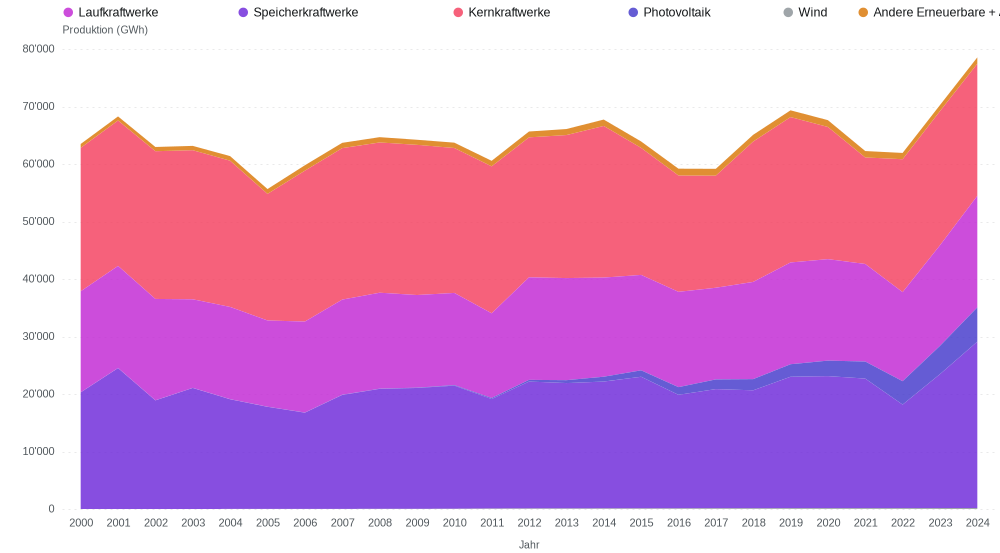
Final energy consumption by sector
Final energy consumption by sector
Data ↗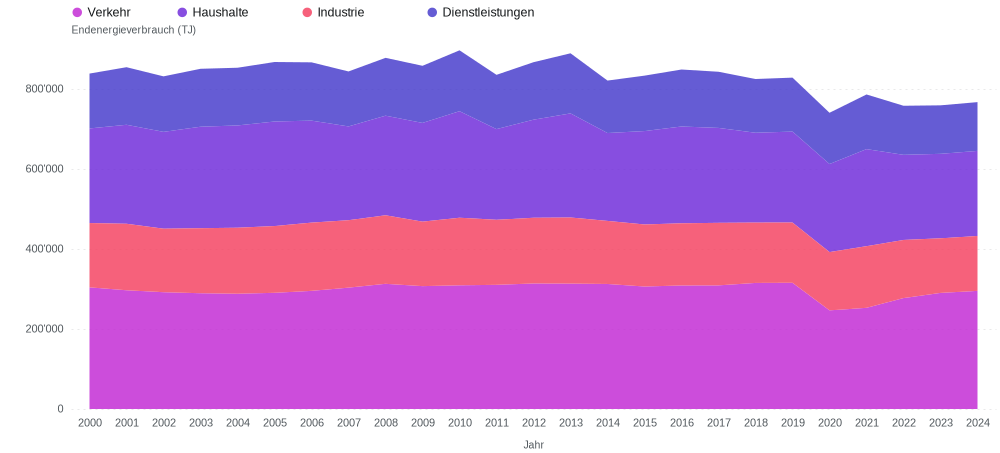
Stress scenarios
Four stress scenarios for Swiss electricity supply
Data ↗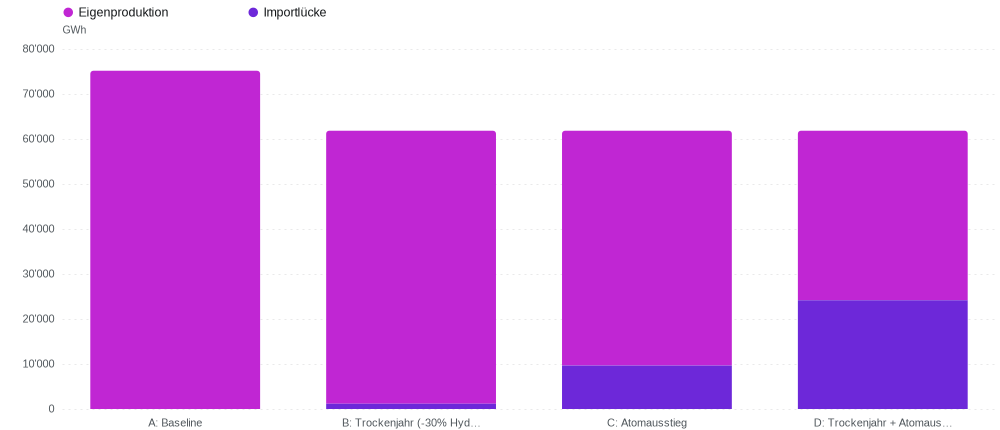
Import costs
Cost of the import gap by scenario
Data ↗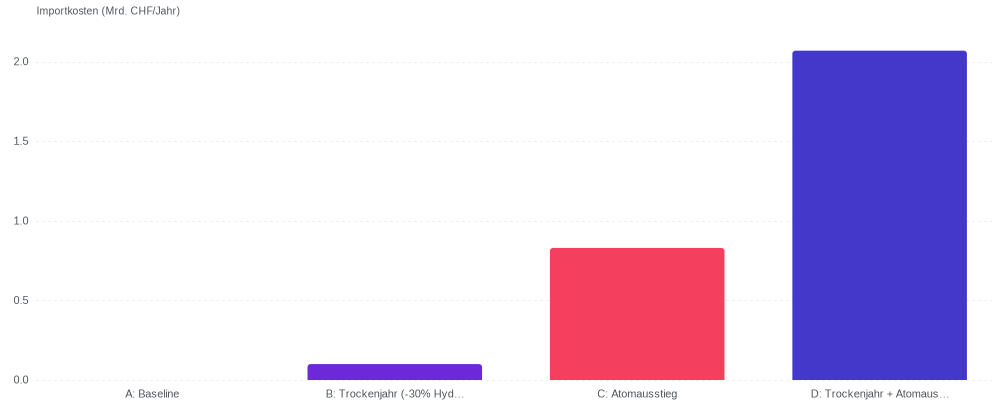
Limitations
- Static scenarios (no expansion of solar/wind, no reduction in demand)
- Import prices fluctuate strongly (2022: up to EUR 400/MWh); EUR/CHF exchange rate as a fixed assumption (0.95)
- Data basis 2024; the SFOE electricity balance 2025 has not yet been incorporated
- Seasonal effects not modelled (winter gap > annual average)
- No storage effects (pumped storage, batteries)
Data sources
- SFOE: Swiss electricity balance (OGD, annual figures)
- SFOE: Swiss overall energy balance (final energy consumption by sector)
- ENTSO-E: European electricity prices (day-ahead spot market)
- Federal Council: press release of 13 August 2025 on the dispatch on the "Blackout stoppen" initiative and the indirect counter-proposal (lifting the ban on new nuclear power plants, in German), https://www.admin.ch/de/newnsb/GIECKzWVs6ZX6W1ba4i6X
Data & code
- Chart data (JSON) · energie_strommix_real
- Chart data (JSON) · energie_verbrauch_sektoren
- Chart data (JSON) · energie_szenarien_vergleich
- Chart data (JSON) · energie_importluecke_kosten
- Code & notebook on GitHub
Change log
- Statements on final energy consumption and import costs corrected (EUR/CHF conversion fixed: around CHF 2.1 instead of 2.3 billion), exchange-rate assumption disclosed and the Federal Council's proposal on the new-build ban added.
Cite as: Die Zukunft, Zukunftslabor (2026): «Electricity Stress Test: What Happens with Drought plus a Nuclear Phase-Out?». https://die-zukunft.ch/en/zukunftslabor/notizen/energieresilienz-stressszenarien/ · CC BY 4.0