The Digital Readiness Gap: The Population Is Online — the State Is Not
90% of Swiss residents use the internet, but e-government and open data lag behind the EU average. The problem is not technological — it is institutional.
Current Checked on 08.11.2026 FSO Omnibus ICT data up to 2025 checked and updated with the e-ID result of 28 September 2025 and the Open Data Maturity Report 2025. Change log (1)
90% of the Swiss population use the internet regularly — but e-government use, online availability and open-data maturity lag behind the EU average. The readiness gap between the digital population and the digital state was 13.2 percentage points in 2025. In 2021 a private-sector e-ID model was rejected at the ballot box (64.4% no); the state-run e-ID was accepted only narrowly on 28 September 2025 (50.4% yes).
Methodology
The analysis combines two FSO Omnibus ICT datasets (2014–2025): internet use by age group (e-mail as a proxy) and e-government use by type of service. The "readiness gap" is the difference between general internet use and e-government use across the whole population. Supplemented by the EU Open Data Maturity Report 2025, the VOX post-vote survey (gfs.bern) on the 2021 e-ID referendum and the official results of the 2021 and 2025 e-ID votes.
Internet use by age group
Internet use by age group in Switzerland
Data ↗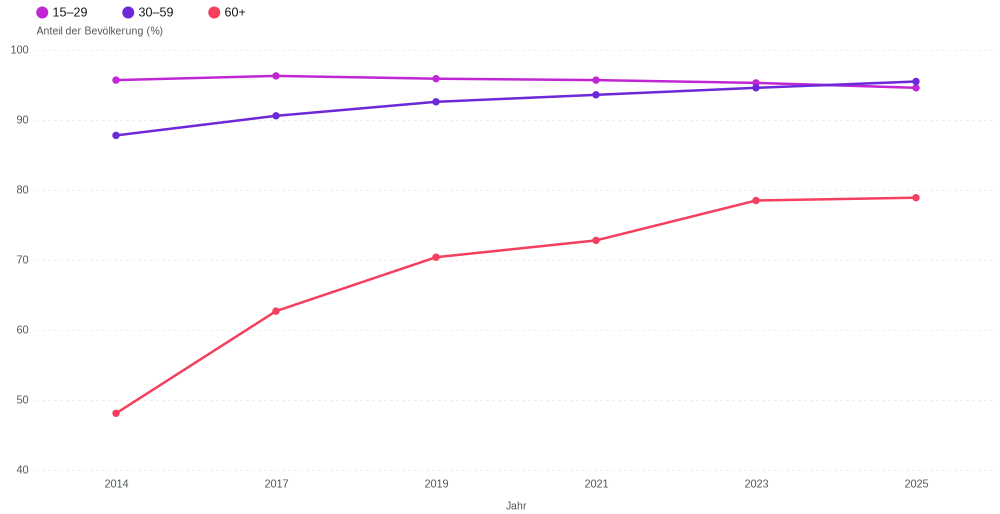
E-government use
E-government use over time
Data ↗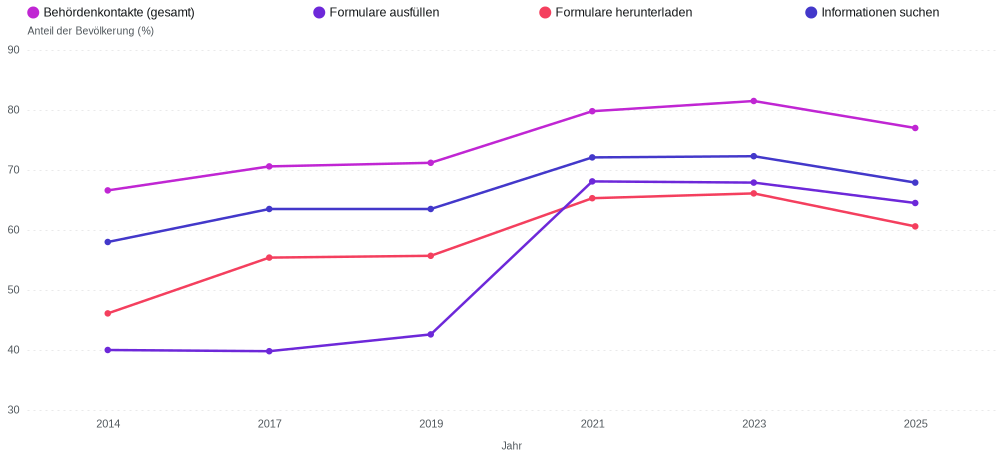
Readiness gap
Digital readiness gap between the population and the state
Data ↗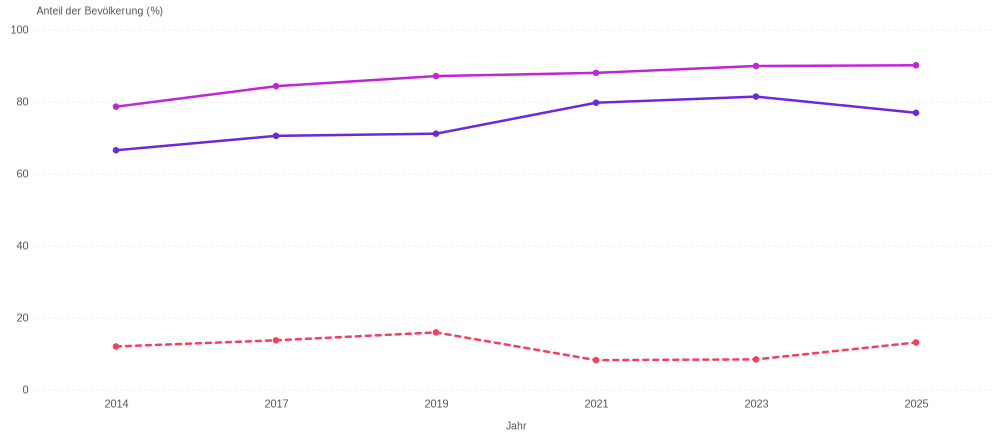
E-ID referendum: a question of trust
Reasons given by no voters in the 2021 e-ID referendum (VOX analysis)
Data ↗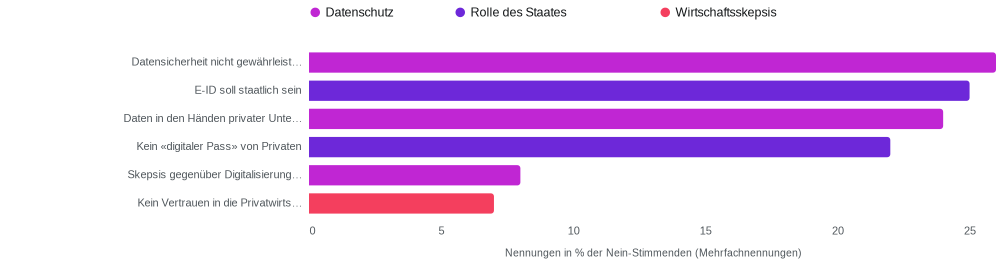
Open-data maturity
Open-data maturity 2025: Switzerland compared with the EU average and selected countries
Data ↗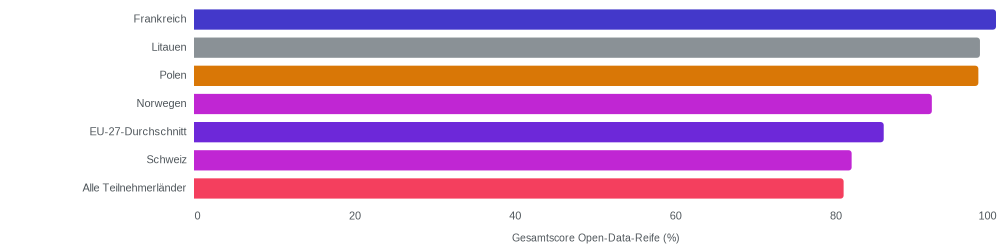
Limitations
- E-mail use as a proxy for internet use (FSO definition)
- E-government data not available by age group — gap can only be calculated at total level
- Open-data score based on EU methodology (Switzerland as a participating EFTA country)
- E-ID motives: VOX post-vote survey with a limited sample, open question with multiple answers
Data sources
- FSO Omnibus ICT 2014–2025: internet use, e-government use
- data.europa.eu: Open Data Maturity Report 2025, https://data.europa.eu/sites/default/files/2025-12/2025_odm_report_7.pdf
- data.europa.eu: Open Data Maturity 2025, country factsheet Switzerland, https://data.europa.eu/sites/default/files/2025-12/2025_odm_factsheet_switzerland.pdf
- gfs.bern: VOX analysis March 2021 (e-ID act, in German), https://swissvotes.ch/vote/639.00/nachbefragung-de.pdf
- Swissvotes: e-ID act of 7 March 2021, rejected with 64.4% no, https://swissvotes.ch/vote/639.00
- SRF: vote of 28 September 2025, e-ID act accepted with 50.4% yes, https://www.srf.ch/news/schweiz/abstimmungen-28-september-so-hat-die-schweiz-abgestimmt
Data & code
- Chart data (JSON) · digital_internetnutzung_alter
- Chart data (JSON) · digital_egov_trend
- Chart data (JSON) · digital_luecke_alter
- Chart data (JSON) · digital_eid_motive
- Chart data (JSON) · digital_opendata_vergleich
- Code & notebook on GitHub
Change log
- Figures on internet and e-government use aligned with the 2025 FSO data, the 2025 e-ID vote and 2025 open-data maturity added, and the motives chart replaced with documented VOX values.
Cite as: Die Zukunft, Zukunftslabor (2026): «The Digital Readiness Gap: The Population Is Online — the State Is Not». https://die-zukunft.ch/en/zukunftslabor/notizen/digitale-souveraenitaet-luecke/ · CC BY 4.0