AHV and VAT: what the numbers say about the 29 November proposal
From 2026 the 13th AHV pension costs around CHF 4.1 billion a year. Together with the federal contribution, the 0.4-point VAT increase covers about half of it. The official figures on deficits, household burden and ageing, without a voting recommendation.
Current Checked on 08.11.2026 Data as of the FSIO financial outlook of July 2026 and FSO scenarios 2025–2055. Change log (1)
With the 13th pension, the AHV's pay-as-you-go result (Umlageergebnis) turns negative in 2026. According to the July 2026 financial projections of the Federal Social Insurance Office (FSIO/BSV), the shortfall is around CHF 1.3 billion in 2026 and, without additional financing, around CHF 4.9 billion in 2035. With the VAT increase that goes to the vote on 29 November, it would be around CHF 3.3 billion in 2035. According to the Federal Tax Administration (FTA/ESTV), an average household would pay around CHF 180 more per year. Underneath lies a demographic trend that none of the three FSO scenarios reverses: in 2025 there are 33 people aged 65 and over for every 100 people of working age; in 2050 there will be 43. We do not give a voting recommendation here.
Methodology
All AHV figures come from the FSIO financial projections of 2 July 2026, in millions of francs at constant 2025 prices. We show the pay-as-you-go result: current revenue minus expenditure, excluding returns on the AHV fund's investments. The FSIO calculates two variants: current law (13th pension from 2026, no additional financing) and the financing of the 13th pension as put to the vote (VAT +0.4 percentage points from 2028, reduced rate unchanged). The FSIO no longer publishes a variant without the 13th pension; we derive it by adding the cost of the 13th pension reported by the FSIO back to the current-law result and subtracting the federal contribution on it (20.2 per cent). This line is our own calculation and is marked as such. The household burden comes from the Federal Council's explanatory booklet (FTA estimate based on the 2018–2019 Household Budget Survey, HBS). Demography comes from the Federal Statistical Office (FSO) scenarios 2025–2055.
Deficits with and without the proposal
AHV pay-as-you-go result 2025 to 2040: current law, with the VAT increase and without the 13th pension
Data ↗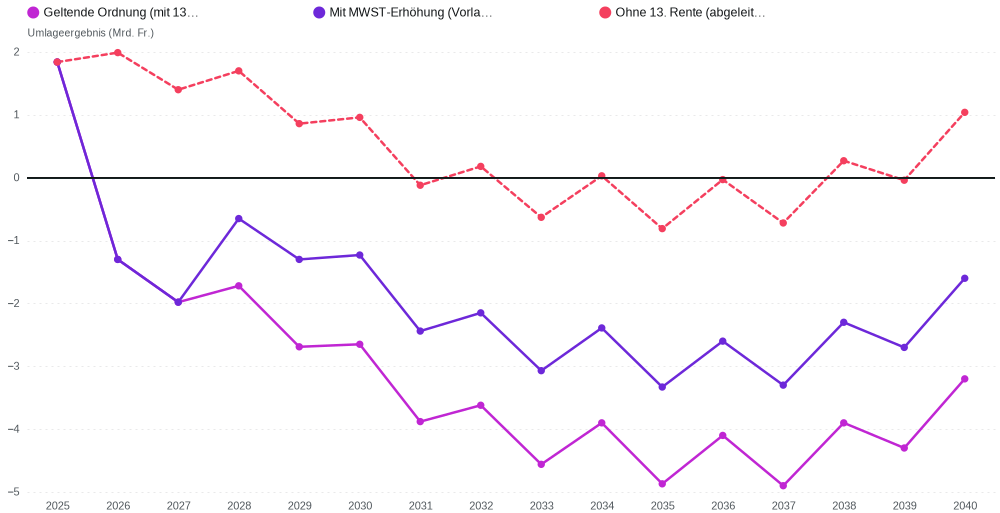
The AHV fund. The law requires the compensation fund to hold, as a rule, at least one year's expenditure (100 per cent). Under current law it falls to 99 per cent in 2027, 51 per cent in 2035 and 23 per cent in 2040, according to the FSIO. With the proposal it would be 68 per cent in 2035 and 53 per cent in 2040. The minimum reserve is therefore undershot in both variants.
The range. Besides the reference scenario, the FSIO calculates a favourable and an unfavourable scenario. Under current law, the 2035 result ranges from –CHF 8.3 billion (low) to –CHF 1.3 billion (high). The FSIO also expresses the 2035 reference deficit in VAT points: without the proposal it equals 1.2 points, with the proposal 0.8 points.
What the increase costs a household
Additional burden from the VAT increase in francs per household and year by income class
Data ↗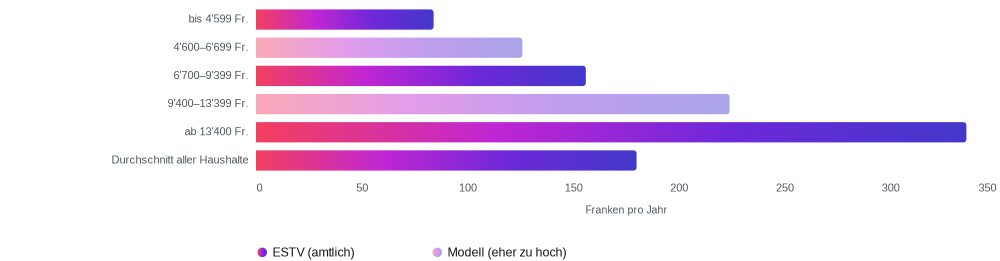
In francs, high-income households pay more; measured against income, they pay less. For a 0.7-point increase, the FTA had calculated in the dispatch 0.41 per cent of gross income for the lowest fifth and 0.26 per cent for the highest. No percentage calculation has been published for the 0.4 points now adopted. At the same time, pensioners receive the 13th pension: up to CHF 2,520 a year for single people and up to CHF 3,780 for married couples.
Demography: the trend beneath the numbers
Old-age dependency ratio 2025 to 2050 under the three FSO base scenarios
Data ↗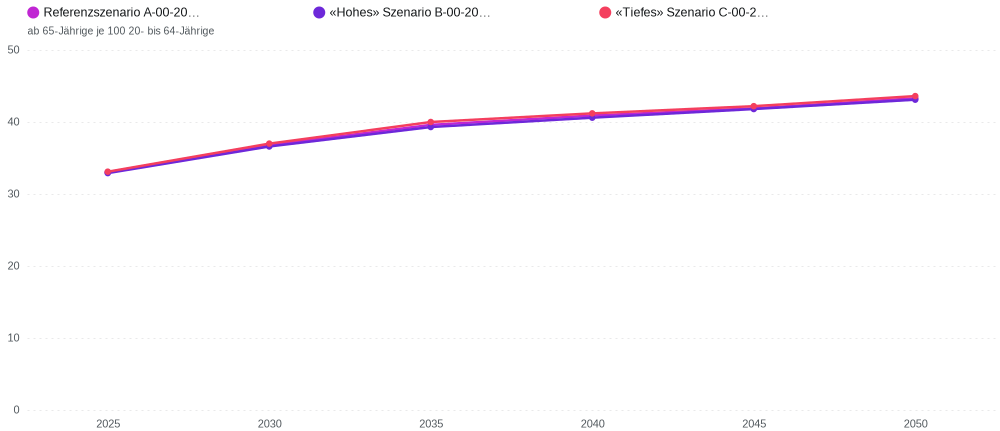
The FSIO uses exactly this FSO scenario A-00-2025 for its reference scenario. Ageing is therefore already built into all the AHV figures above.
What the numbers do not say
- No certainty beyond 2035. The FSIO itself states that projections beyond ten years are subject to great uncertainty. The range for 2035 runs from –CHF 1.3 to –CHF 8.3 billion.
- No investment returns. The pay-as-you-go result leaves out the AHV fund's returns; for the fund level, the FSIO assumes a real return of around 2 per cent. Good or bad market years shift the fund level noticeably.
- Old consumption data. The household figures are based on 2018–2019 prices and consumption. According to the booklet, the actual burden is likely to be somewhat higher. Pass-through to prices is also an assumption: firms do not always pass on an increase in full.
- No net balance per household. The figures show the burden of the tax, not the balance with the 13th pension. Whether a household gains on balance depends on whether, and how much, AHV pension it receives.
- Open parameters. Whether the special rate for accommodation continues beyond 2027 was still open when the booklet went to press. The Federal Council intends to present the AHV2030 reform in spring 2027; it will change the projections.
- No verdict on the right financing. The figures show how large the gap is and who bears how much. Whether VAT, wage contributions, federal funds or benefit adjustments are the right path is a political question, not a statistical one.
Context
Our reading of the four proposals of 29 November, also without a voting recommendation, is in the article 29 November 2026 vote. Why we care about financing social insurance through consumption rather than through wages alone is explained in the Basic Income pillar; how different tax bases affect income distribution is shown in the note Basic Income: Three Financing Models Compared.
Sources
- Federal Social Insurance Office (FSIO/BSV): Financial situation and outlook of the AHV, financial projections of 2 July 2026. https://www.bsv.admin.ch/finanzen-ahv
- FSIO: AHV financial projections under current law (reference, low and high scenarios), 2 July 2026. https://www.bsv.admin.ch/dam/de/sd-web/op2mTMWV0HCj/Finanzperspektiven%20der%20AHV%20gem%C3%A4ss%20geltender%20Ordnung.xlsx
- FSIO: AHV financial projections with financing of the 13th pension (incl. "Massnahmen" sheet), 2 July 2026. https://www.bsv.admin.ch/dam/de/sd-web/jnnnev0Cvqna/Finanzperspektiven%20der%20AHV%20gem%C3%A4ss%20Finanzierung%20der%2013.%20Altersrente.xlsx
- FSIO: Key facts: financial projections of the AHV, IV and EO with scenarios, 2 July 2026. https://www.bsv.admin.ch/dam/de/sd-web/layXpeKUCS4Y/Faktenblatt%20Szenarien_2026_DE.pdf
- Federal Chancellery: Federal Council explanatory booklet for the vote of 29 November 2026, pp. 13–19 (German edition). https://www.admin.ch/dam/de/sd-web/HXhFMFWOaa6u/BAR_Erlaeuterungen_Nov26_DE_v10.pdf
- FSIO: 13th AHV pension: vote on the additional AHV financing. https://www.bsv.admin.ch/de/abstimmung-13-ahv-rente
- Federal Council: Dispatch of 16 October 2024 on the implementation and financing of the 13th AHV pension initiative, BBl 2024 2747, section 6.5, tables 6–4 and 6–5. https://www.fedlex.admin.ch/eli/fga/2024/2747/de
- Federal Statistical Office (FSO): Population scenarios for Switzerland and the cantons 2025–2055, tables TA7–TA9. https://www.bfs.admin.ch/asset/de/34687099
- FSO: Projections – reference scenario 2025–2055 (fact sheet). https://dam-api.bfs.admin.ch/hub/api/dam/assets/34687124/master
- Federal Parliament: Questions and answers on the financing of the 13th AHV pension, 19 June 2026. https://www.parlament.ch/de/services/news/Seiten/2026/20260619104626831194158159026_bsd070.aspx
Data & code
- Data (CSV)
- Chart data (JSON) · ahv_umlageergebnis_szenarien
- Chart data (JSON) · ahv_mwst_haushalte
- Chart data (JSON) · ahv_altersquotient
Change log
- First publication.
Cite as: Die Zukunft, Zukunftslabor (2026): «AHV and VAT: what the numbers say about the 29 November proposal». https://die-zukunft.ch/en/zukunftslabor/notizen/ahv-mehrwertsteuer-zahlen/ · CC BY 4.0